Expert Interview Tips by Silchar Job Consulting — #1 North East Placement & Recruitment Consultant Solution Agency
In today’s ruthlessly competitive employment landscape, a job interview is not merely a conversation — it is a high-stakes professional evaluation where every word can determine whether you secure the offer or lose the opportunity permanently. Employers assess far more than qualifications; they analyze attitude, emotional intelligence, cultural compatibility, accountability, and long-term value potential.
At Silchar Job Consulting, headquartered in Silchar, recruiters consistently observe that many capable candidates sabotage their own chances by making avoidable verbal mistakes. Even highly skilled applicants can be rejected instantly due to careless statements that signal risk, negativity, entitlement, or lack of professionalism.
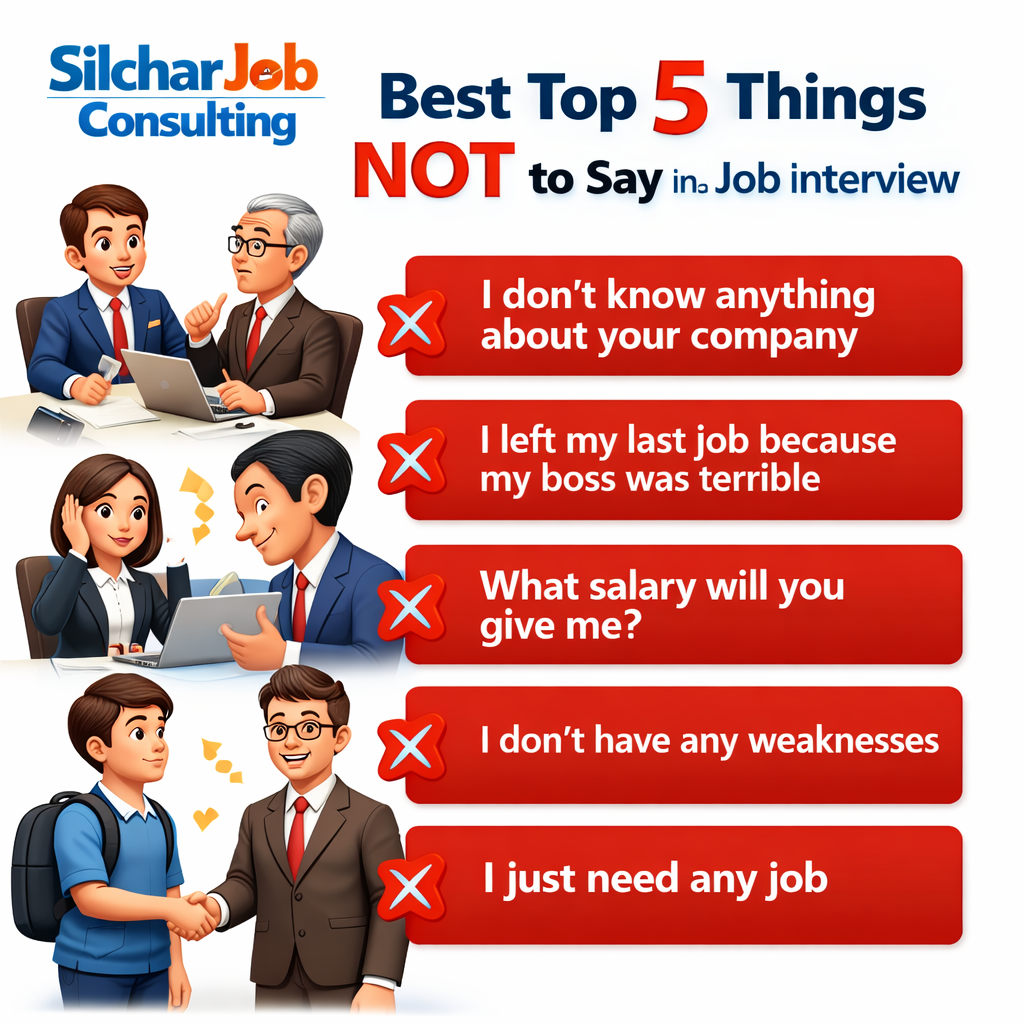
This authoritative guide outlines the Top 5 Critical Statements You Must Never Say in a Job Interview, along with psychologically informed explanations and superior alternatives that demonstrate executive-level communication skills.
- “I Don’t Know Anything About Your Company.”
Why This Is Catastrophic
This statement communicates intellectual laziness, lack of initiative, and minimal interest in the role. From an employer’s perspective, if a candidate cannot invest 30 minutes researching the organization, they are unlikely to demonstrate diligence on the job.
Hiring managers interpret this as:
Low motivation
Poor preparation habits
Weak analytical curiosity
Transactional job seeking (salary-only focus)
High probability of disengagement
In an era of abundant digital information, ignorance is inexcusable.
What Employers Expect Instead
Candidates should demonstrate strategic awareness of:
Core products or services
Market positioning
Organizational values
Recent developments or achievements
Industry challenges
Professional Alternative
“I reviewed your organization’s recent initiatives and was particularly impressed by your expansion in [specific area]. I believe my experience aligns strongly with those goals.”
This response signals preparation, analytical thinking, and genuine interest. - “I Left My Last Job Because My Boss Was Terrible.”
Why This Raises Immediate Red Flags
Negative commentary about previous employers indicates potential workplace toxicity. Recruiters fear that such candidates may:
Create conflict within teams
Resist authority
Lack emotional maturity
Violate confidentiality norms
Repeat the same narrative about their new employer later
Even if the complaint is valid, expressing it bluntly demonstrates poor professional judgment.
Psychological Interpretation by Hiring Managers
Organizations seek stability. Candidates who display blame-oriented language appear high-risk for:
Complaints escalation
HR issues
Poor team cohesion
Low resilience
Professional Alternative
“I’m looking for an environment that offers greater opportunities for growth, structured leadership, and long-term career development.”
This reframes the narrative positively while preserving dignity. - “What Salary Will You Give Me?” (Asked Too Early)
Why Timing Matters
Compensation is important, but prioritizing salary before demonstrating value signals opportunism rather than commitment. Employers prefer candidates who first focus on contribution, responsibilities, and organizational fit.
Premature salary discussions suggest:
Short-term mindset
Lack of strategic thinking
Potential for rapid job switching
Minimal intrinsic motivation
Employer Perspective
Recruiters want to assess capability before discussing compensation structures. Early emphasis on money undermines negotiation leverage.
Professional Alternative
“I’m open to a compensation package that is fair and aligned with the responsibilities of the role. I would be happy to discuss specifics later in the process.”
This communicates professionalism, flexibility, and confidence. - “I Don’t Have Any Weaknesses.”
Why This Appears Dishonest
Self-awareness is a core leadership competency. Claiming perfection suggests either arrogance or lack of introspection. Modern organizations value employees who can recognize limitations and pursue improvement.
Hiring managers interpret this as:
Low coachability
Defensive personality
Limited growth potential
Poor feedback tolerance
What Employers Actually Want
They are not seeking perfection; they are evaluating:
Honesty
Emotional intelligence
Learning mindset
Accountability
Professional Alternative
“Earlier in my career, I tended to focus excessively on details, which occasionally slowed project timelines. I’ve since learned to balance precision with efficiency by prioritizing critical tasks.”
This demonstrates maturity, self-improvement, and adaptability. - “I Just Need Any Job.”
Why This Destroys Your Personal Brand
While desperation may be understandable, expressing it openly signals that the candidate lacks direction, ambition, and loyalty. Employers want individuals who intentionally choose their organization, not those who view it as a temporary fallback.
Negative implications include:
Low engagement probability
Minimal commitment
High turnover risk
Lack of career vision
Organizational Risk Assessment
Training employees is expensive. Companies prefer candidates who are likely to remain and contribute meaningfully over time.
Professional Alternative
“This role strongly aligns with my skills and long-term career objectives, particularly in [specific domain]. I am eager to contribute and grow within your organization.”
This reframes urgency into purposeful ambition.
Additional Critical Mistakes to Avoid
While the five statements above are the most damaging, several other verbal missteps can also reduce hiring probability:
Interrupting the interviewer
Providing excessively long or irrelevant answers
Using slang or informal language
Displaying overconfidence without evidence
Asking questions already answered in the job description
Discussing personal problems unrelated to work
Professional communication requires precision, clarity, and relevance.
What Employers Truly Evaluate During Interviews
Beyond technical qualifications, organizations assess multidimensional competencies:
Communication Competence
Clarity, articulation, listening ability, and professional vocabulary.
Cultural Compatibility
Alignment with organizational values, teamwork orientation, and adaptability.
Problem-Solving Capability
Ability to analyze situations logically and propose actionable solutions.
Professional Demeanor
Confidence balanced with humility, respect, and composure under pressure.
Long-Term Potential
Likelihood of growth into leadership roles and sustained contribution.
Silchar Job Consulting trains candidates to excel across all these dimensions.
Advanced Interview Preparation Strategies
Elite candidates adopt a systematic preparation approach:
Conduct Deep Organizational Research
Use official websites, industry reports, news coverage, and professional networks to understand the employer’s strategic position.
Prepare STAR-Based Responses
Structure answers using:
Situation
Task
Action
Result
This method demonstrates measurable impact rather than vague claims.
Develop Insightful Questions
High-quality candidates ask thoughtful questions about:
Team structure
Performance expectations
Growth pathways
Organizational challenges
This signals intellectual engagement.
Practice Professional Body Language
Nonverbal cues often influence decisions as strongly as verbal responses. Maintain:
Eye contact
Upright posture
Controlled gestures
Calm facial expressions
How Silchar Job Consulting Prepares Candidates for Success
As the leading recruitment consultancy in North East India, Silchar Job Consulting provides comprehensive interview readiness programs, including:
Resume optimization
Mock interview simulations
Industry-specific coaching
Communication enhancement training
Confidence building workshops
Career path consultation
Thousands of successful placements attest to the effectiveness of this methodology.
The Long-Term Value of Professional Interview Skills
Interview competence is not a one-time requirement; it is a lifelong career asset. Professionals who master persuasive communication gain advantages in:
Promotions
Leadership opportunities
Client negotiations
Public speaking
Professional networking
Thus, investing in interview skills yields exponential returns over time.
Final Thoughts
A job interview is fundamentally a strategic dialogue where employers assess risk versus reward. Even exceptional qualifications cannot compensate for poor communication choices. By avoiding the five critical statements outlined above and adopting polished alternatives, candidates dramatically increase their probability of success.
Silchar Job Consulting — #1 Top North East Placement & Recruitment Consultant Solution Agency — remains committed to empowering job seekers with world-class guidance, ethical recruitment practices, and access to verified career opportunities.
Whether you are a fresher entering the workforce or an experienced professional seeking advancement, mastering interview communication is the decisive factor that transforms potential into achievement.